ComMarker B6 vs Haotian 60W MOPA
These are the two 60W MOPA machines that come up most often when someone is buying their first serious fiber laser, and they get compared constantly in forums and Facebook groups. The comparison usually stalls on spec sheets. Specs aren’t the interesting part here — both machines will mark the same materials to the same quality. What separates them is price, support, and how much patience you have for setup.
Here’s the honest version of the difference, and who each one actually fits.
Side by Side
| ComMarker B6 MOPA | Haotian 60W MOPA | |
|---|---|---|
| Power | 60W | 60W |
| Laser Source | JPT MOPA | JPT MOPA (M7) |
| Approx. Price | $2,500–$3,000 | $4,000–$4,500 |
| Warranty | Standard manufacturer warranty | 3-year warranty on most listings |
| Colour on stainless | Yes | Yes |
| Best For | General small-business use | Higher-volume production |
| Setup Difficulty | Easier for first-time buyers | Better for buyers already comfortable with laser settings |
| Support | Established Western support presence | Direct from manufacturer |
The Thing Nobody Mentions: They Mark the Same
Both machines run a JPT MOPA source at 60W. That means the physics of what lands on your workpiece is effectively identical. A colour-anodised aluminium tag off the B6 and the same tag off the Haotian will not be distinguishable by a customer, or by you.
This matters because most comparison content implies you’re choosing between quality tiers. You aren’t. You’re choosing between two routes to the same output. Once you accept that, the decision gets much simpler — it becomes a question about money, support, and time, which are things you can actually reason about.
Where the ComMarker B6 Wins
Price, by a wide margin. At roughly $2,500–$3,000 against $4,000–$4,500, you’re looking at $1,000 to $2,000 in difference. For a business that hasn’t earned its first dollar yet, that gap is not abstract — it’s a rotary attachment, a proper fume extractor, your first few hundred blanks, and a month of ads. Spending it on a machine that marks identically is a poor trade.
It’s built to be approachable. ComMarker has spent years selling into the Western hobbyist-to-small-business market, and it shows in the documentation, the software workflow, and the volume of community tutorials. When you get stuck at 11pm trying to work out why your colour pass is coming out brown instead of blue, the odds that someone has already posted the answer are much higher for the B6.
Support you can reach. An established support presence in your timezone is worth real money the first time something goes wrong. This is the least exciting advantage on the page and probably the most valuable.
Where the Haotian 60W Wins
Warranty coverage. Three years on most listings, against a standard manufacturer warranty on the B6. On a machine you’re depending on for income, warranty length is not a spec-sheet nicety — it’s how long you’re insured against a fault that would otherwise stop your production line.
Built for sustained running. The Haotian is positioned for buyers running the machine hard rather than occasionally. If you’re already fulfilling daily orders and the laser is the bottleneck, the case for it strengthens considerably.
Direct from the manufacturer. Fewer links in the chain, which some buyers prefer for parts and replacement sourcing. It also means less hand-holding, which is exactly why it suits an experienced operator and frustrates a beginner.
Total Cost, Not Sticker Price
Neither machine arrives ready to earn money. Budget for these regardless of which you pick:
- Fume extraction: $200–$1,000. Marking metal produces particulate you should not be breathing. This is not optional equipment.
- Rotary attachment: $200–$500. Required for tumblers, rings, and anything cylindrical — which is a large share of what sells.
- Blanks and test material: $300–$1,000. You will burn through material learning your settings. Budget for the learning, not just the production.
- Safety glasses rated for 1064nm: $50–$150. Fiber wavelength is invisible. Ordinary safety glasses do nothing.
Add $750–$2,650 to whichever machine you choose. A buyer who stretches to the Haotian and then has nothing left for extraction and a rotary is worse off than one who buys the B6 fully equipped.
Which One Should You Buy?
The decision comes down to one question: is your business currently limited by your machine, or by your order book?
If you don’t yet have more orders than you can fill, machine capability is not your constraint and the extra $1,500 buys you nothing. Buy the B6, spend the difference on the accessories and the marketing that actually generate orders.
If you’re already turning work away or running long days to keep up, you have a throughput problem, and the Haotian’s warranty and sustained-use positioning start earning their premium.
Choose the ComMarker B6 if this is your first commercial laser
Most people reading a page like this are buying their first serious machine. For that buyer the B6 is the sounder purchase — same marking capability, meaningfully lower cost, gentler learning curve, and support that’s easier to reach. Keep the saved money working in the business.
If you’re already running daily volume and the laser is what’s slowing you down, the Haotian’s longer warranty and production positioning justify the step up. That’s a genuinely different buyer with a genuinely different problem.
See the Full 60W Lineup →Common Questions
Will one produce better colour than the other?
No. Colour on stainless comes from pulse control, which both machines have as MOPA sources at the same wattage. Your settings and your material will affect colour far more than your choice between these two.
Is 60W the right power for either of these jobs?
For most small businesses, yes — it’s the practical sweet spot. If your work is small and highly detailed, like jewellery, 30W is often enough and cheaper. If you’re running production all day, look at whether 100W is worth it.
Can either engrave wood, acrylic or leather?
Not well. Fiber and MOPA lasers work at 1064nm, which metals and some plastics absorb but organic materials largely don’t. If you need wood and leather too, look at a CO2 machine or a dual-source setup — covered in our small business fiber laser guide.
How long before either pays for itself?
That depends entirely on your order volume and pricing, not on the machine. A laser sitting idle never pays for itself at any price. Work through the numbers in how to start a laser engraving business before committing.
Where to Go Next
- MOPA Laser Engraver Buying Guide — start here if you haven’t bought yet
- Best 60W MOPA Fiber Lasers
- Best MOPA Laser for a Business
- How to Start a Laser Engraving Business
Which laser is right for your work?
Answer three questions. I'll point you at the machine that actually fits.
1. What are you marking most?
2. What matters most?
3. Your budget?
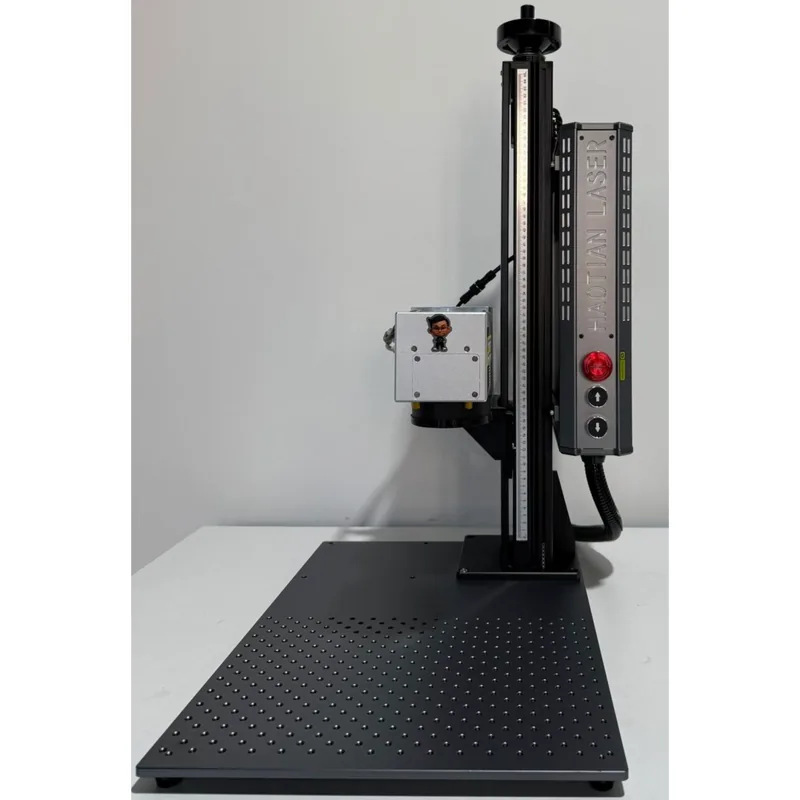
Haotian 50W JPT M8 MOPA Fiber Laser
4.9The 60W JPT M7 source is the colour-marking benchmark. Deepest engraving of the three MOPA picks.
- 60W JPT M7 MOPA source
- Full colour marking on stainless
- 1-500ns adjustable pulse width
- Deep engraving and annealing in one machine