Where to Buy Blanks for Laser Engraving
Disclosure: Some links on this site are affiliate links. Almost none on this page are the best suppliers here who don’t run affiliate programs, and we’re recommending them anyway; here’s how that works.
Two shops sell the same engraved tumbler for $28. One makes $19 on it. The other makes $6. Neither is working harder than the other; one just buys a trade, and one buys retail.
Where you source blanks is the least glamorous decision in a laser business and one of the few that changes the arithmetic of every order you will ever take. This is how the supply tiers actually work, what a wholesale account requires, and when paying retail is genuinely the right call.
The Four Tiers
| Tier | Typical unit cost on a 20oz tumbler | Account needed | Best for |
|---|---|---|---|
| Trade wholesale. | $6–$10 | Yes, resale certificate | Anything you sell repeatedly |
| Bulk online (Alibaba, etc.) | $4–$8 | No, but MOQs apply. | High volume, accepted risk |
| Craft retail | $12–$18 | No | Samples and one-offs |
| Amazon / big box | $14–$22 | No | Testing a product idea fast |
The spread between the top and bottom rows is roughly $8–$12 per unit on a single product. Sell forty a month, and that’s $400 in margin that exists or doesn’t purely because of where you clicked “buy.”
It compounds worse than it looks, because retail pricing also caps what you can offer on volume orders. The B2B client who wants fifty branded tumblers is the customer most worth having, and you cannot quote them competitively on retail stock.
Trade Suppliers
We earn nothing from this section. Neither supplier below runs an affiliate program; they’re trade wholesalers, and you open an account with them directly. We’re recommending them because they’re the right answer, and you should know which parts of a site like this pay us and which don’t. That is why MOPA Laser Engraver Buying Guide exists.
JDS Industries is the default for most US engraving shops. Broad catalogue across drinkware, awards, signage, and gifts, with genuine trade pricing and reliable stock. If you open one account, open this one.
Johnson Plastics Plus (JPPlus) overlaps heavily but leans more heavily on engraving substrates, plastics, and materials rather than finished giftware. Most established shops end up with both accounts and buy from whichever has the item in stock.
Regional distributors exist too and are worth finding; freight on a heavy order from three states away can quietly erase the price advantage you opened the account for.
What opening an account actually takes
Less than people expect, and it’s the single most common thing new shops put off for no reason:
- A resale certificate (sales tax permit) from your state, usually free or near-free, applied for online, issued in days
- A business name and address. A registered entity helps; sole proprietors are frequently accepted
- Sometimes a first-order minimum is typically modest, often around $100
That’s it. The barrier is administrative, not commercial, and it exists to keep trade pricing away from consumers rather than to keep you out. If you’re forming an entity anyway, the startup guide covers that step.
Open the account before you think you need it. The pricing difference applies to every order you’ll ever place, and there’s no advantage to waiting.
When Retail Is Actually Correct
Trade-only is dogma, and dogma costs money too. Buy retail when:
- You’re validating a product. Buy three at retail, engrave them, list them, and see if anyone bites. Committing to a case of forty-eight before you know it sells is how shops end up with shelves of inventory in a color nobody wanted.
- A customer wants something outside your catalogue. One-off, priced accordingly, sourced wherever is fastest.
- You need it this week. Rush freight on a wholesale order frequently costs more than buying local retail.
Retail is a testing and emergency channel. Without knowing where to buy blanks for laser engraving, you risk running your whole product line through it.
What to Check Before Committing to a Product
Not every blank engraves the way its listing implies, and finding out at volume is expensive.
- Is the coating laserable? Powder-coated drinkware is the common case; some coatings ablate to a clean contrast, others go muddy or grey. “Laserable” in the product title is not the same as good.
- Is the metal actually what it says? Cheap “stainless” tumblers are frequently plated. Plating marks unpredictably and won’t take MOPA color.
- Buy a sample first. Always. One of anything before forty of it.
- Check lot consistency. Coating thickness varies between production runs, and settings dialled in on one lot can need adjusting on the next. Keep a settings note per supplier and product.
That last point catches experienced shops out. When a job that worked perfectly last month suddenly comes out wrong, the blank changes more often than the machine does.
Sourcing Overseas
Alibaba and similar platforms can beat domestic trade pricing meaningfully, and for a high-volume product line, the math can genuinely work. The costs that don’t appear on the quote:
- Minimum order quantities frequently in the hundreds
- Lead times of four to eight weeks, which removes reordering as a quick fix
- Duties and freight, which vary and are easy to underestimate
- Quality variance with limited recourse when a batch is wrong
Sensible sequence: prove the product domestically, establish reorders, then look overseas for that specific item. Not as a starting point.
Building the Cost Into Your Pricing
Whatever you pay, mark materials up 2×–3×. That covers the pieces you scrap while dialling in settings, the ones that arrive damaged, and the capital sitting in stock on your shelf.
Cheaper blanks don’t mean lower prices; they mean better margins at the same price. Sourcing well is a margin decision, not a pricing one, and shops that pass their sourcing advantage straight to the customer have given away the only structural edge they had.
Run your actual numbers through the shop rate calculator with both a retail and a trade material cost. The difference in what you take home is usually the argument that finally gets the wholesale account opened.
Common Questions
Do I need an LLC to open a wholesale account?
Usually, not; a resale certificate and a business name are the core requirements, and sole proprietors are commonly accepted. Requirements vary by supplier and state, so check with the specific supplier rather than assuming.
What’s the minimum order at trade suppliers?
Often around $100 for a first order, sometimes less, and frequently nothing after the account is established. Lower than most people assume.
Can I buy wholesale without a business?
Generally, no; the resale certificate is the gate, and it requires being registered to collect sales tax. That requirement is the whole reason trade pricing stays below retail.
Which blanks sell best?
Drinkware and tumblers move most consistently for consumer sales. But the less crowded and less seasonal money is in industrial and promotional work: asset tags, tool marking, and serialization, where businesses reorder on a schedule. That’s covered in getting your first customers.
Where to Go Next
- How to Price Laser Engraving Jobs: What Your Material Cost Does to Your Rate
- Tools and Suppliers: The Recurring Cost Stack Beyond Blanks
- Getting Your First Customers Who Actually Reorder
- How to Start a Laser Engraving Business
Which laser is right for your work?
Answer three questions. I'll point you at the machine that actually fits.
1. What are you marking most?
2. What matters most?
3. Your budget?
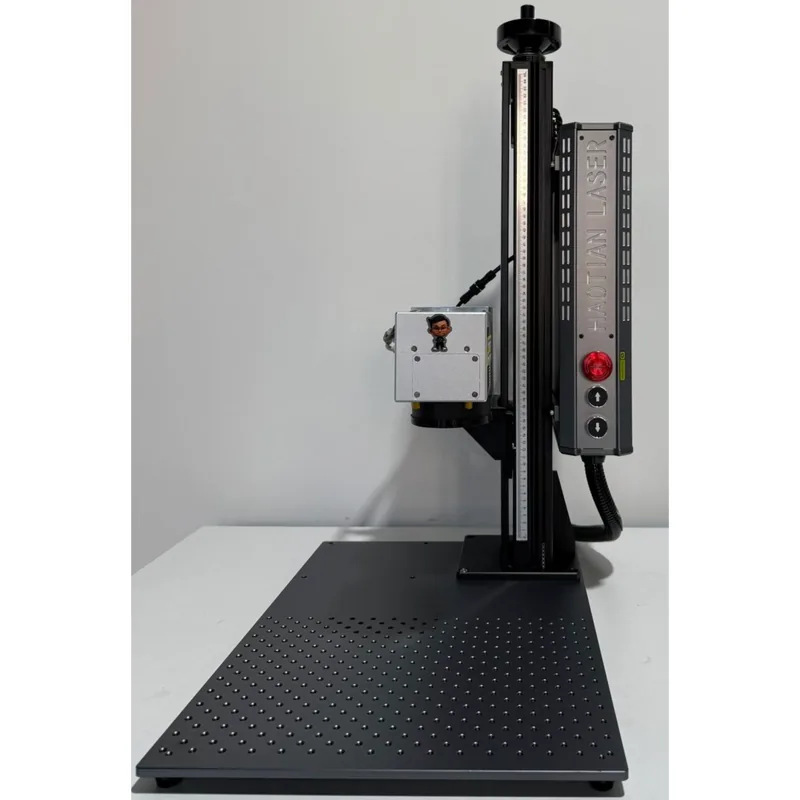
Haotian 50W JPT M8 MOPA Fiber Laser
4.9The 60W JPT M7 source is the colour-marking benchmark. Deepest engraving of the three MOPA picks.
- 60W JPT M7 MOPA source
- Full colour marking on stainless
- 1-500ns adjustable pulse width
- Deep engraving and annealing in one machine